You’ve probably heard the phrase, “Release the Kraken!” Pyrates my age or older will have first heard this cry in the campy (but much loved) 1981 original movie, Clash of the Titans. The kraken in that movie was a rather strange creature: Although massive in size, it did not resemble the more traditional image of an octupus-like monster. It was more like a reptilian, four armed King Kong with scales instead of fur. The CGI back in 1981 was pretty awful, so the movie visual wasn’t terrifying, but the idea of a massive monster emerging from the depths of the sea was. At least to me.

Some recent pyrate movies, (perhaps most notably Pirates of the Caribbean: Dead Man’s Chest), feature encounters with krakens as well. Unlike Clash of the Titans, the visual in Dead Mean’s Chest is spot on: An enormous octupus that is able to envelope entire ships with its tentacles and then tear them apart like butter.

However, there is a wee little problem with including krakens in stories set in the Caribbean: Kraken don’t live in the Caribbean. In fact, the kraken’s watery abode is North. WAY north.
Wait, weren’t we talking about how to make a lusca angry? What happened to that?
Hang tight, we’re getting there.
The word ‘kraken’ is a Norwegian word. The origin of ‘kraken’, experts think, comes from the Norwegian root word ‘krake’ which means malformed or crooked tree. Kraken were first officially recorded in writings from 1700 and again in 1753; however, they are a part of Norwegian mythology going much further back. The writings of the 18th century specifically mention size, (‘tremendous”), and strength, (ship killers). Krakens became even more infamous when Victor Hugo and Jules Verne included the beasts in their novels, Toilers of the Sea (1866) and 20,000 Leagues Under the Sea (1869), respectively.

As frightening as krakens are rumoured to be, ye don’t need to worry about them while sailing (or swimming) in the Caribbean.
Now, there IS a Caribbean sea monster that is a distant cousin of the kraken. These monsters are believed to lurk in the deep, blue holes near the island of Andros in the Bahamas: The Lusca.

It shares some characteristics with its distant cousin, the kraken:
- Enormous
- Tentacles
- Can and will tear ships to shreds
- Can and will attack humans
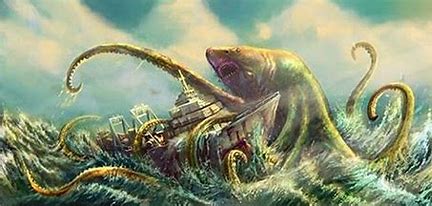
In Caribbean folklore, the lusca is described as a half-shark / half-octupus creature that can grow to over 70 feet in length. It has also been said to resemble a cuttlefish, (which kinda looks like a half-shark / half-octupus.) Maybe cuttlefish are baby luscas? That’s a strange and frightening thought, huh?

So, the knowledge gleaned in today’s wonderin’ and plunderin’ with Bootstrap Ginny is:
- When in the northern oceans, keep your eyes open for kraken-sign and steer well clear when spotted.
- When in Caribbean waters, avoid sailing near and certainly not into a blue hole
If you do encounter a lusca, know this (and here is what you’ve been waiting for!) it makes a lusca very, very angry when they are called a ‘kraken’.
So, don’t.
 Virginia Chandler
You must be logged in to post a comment.